GROW+LOOK+EAT :: PLANTATION PARK AT TEMPELHOF


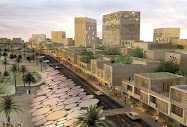
MASTER PLAN

\\\ living in a green farming area: buildings are surrounded by green spaces and farming areas

\\\ offering a spectacular and attractive living space: more and more people get conscious about health and consumption

\\\ additional farming for partial feeding the residents and visitors 

\\\ plantation park as an adventure for everyone

\\\ autonomy in terms of energy (solar energy, geothermal heating and cooling and wind power) 

\\\ car free transportation by use of bicycles, car sharing with electric vehicles, and pedestrian scale zoning

\\\ creating an attractive street system which is comfortable for slower transportation like bicycles and pedestrians


ECONOMIC INTENT

\\\ saving money through independence from the energy grid of Berlin

\\\ saving construction materials by shared community areas


ECOLOGICAL INTENT

\\\ using low carbon materials like steel, wood, and local materials

\\\ using renewable energy (geothermal heating and cooling, wind power, solar energy)

\\\ create an ecological environment by farming areas next to housing areas

\\\ green facades to produce oxygen and to grow vegetables right next to the balcony (vertical farming)


SOCIAL INTENT

\\\  encourage consciousness for the environment, consumption, low carbon life style and climate change through a new housing environment that uses the energy it produces

\\\ identification by individual designs and indentity through „baugemeinschaften“ (community building)

\\\ community living in shared spaces by old, young, handicaped people living together


ARCHITECTURAL INTENT

\\\ low carbon materials 

\\\ solar panels as a designing element

\\\ additional farming on the facades


The 2009 Berlin Summer Academy has come to a close. The focus of this year's studio was Tempelhof Airport, in Berlin. The airfield at Tempelhof, just two miles from the city center and encompassing an area of 340 hectares, was closed to air-traffic in October 2008. The shear size of the airfield and its proximity to central Berlin immediately established the site as one laden with potential for creative development. Global and local economic woes, a shrinking population, and pressures of climate change, however, bring to question the necessity of unbridled development and call for a more creative solution. Potsdamer Platz -- another site in central Berlin vacant until reunification -- provides one strategy for development of an urban core. Students were asked to explore others.

The challenge is unprecedented.


A series of lectures and panels focussing on urban design strategies and sustainability were organized to offer context and insight. The speakers at this year's summer academy included:

markus bader :: raumlabor
michael lafond :: experiment city
rolo fütterer :: belval-ouest
ingrid pohl :: burro happold
susan draeger :: burro happold
fritz reusswig :: potsdam institue
peter raacke :: raacke design 
thomas lechner :: transsolar


Using the input and lessons learned from the panel discussions, students worked individually to develop strategies for the development of Tempelhof. Keeping climate change, a shrinking population and economic base, and changing modes of mobility in mind, design work began with site plans at the urban scale, then focused on strategies for a single block, and finally the design of a single building.

In the coming weeks, the work will be presented on this blog for comment and critique.


[building talks] at AEDES

panel discussion: LOW CARBON LIFESTYLE

**Sabine M. Müller & Andreas H.K. Quednau, SMAQ
http://www.smaq.net/
**Dr. Susanne Rexroth & Prof. Dr. Friedrich Sick, HTW Berlin
http://www.energie-kompetenz.fhtw-berlin.de/en/kontakt.htm

**Oliver G. Hamm, moderation

Thu 2 July 19.00
Aedes Network Campus berlin, pfefferberg
Christinenstr. 18-19
10119 Berlin, Germany
(U-bahn Senefelderplatz)


http://www.burohappold.com/bh/home.aspx
http://www.aedes-arc.de/

2. Standortkonferenz - new uses for TXL airport

WORKSHOP TXL:
Second open discussion for new uses for Tegel airport after closing date 2011.

Participants:

**Senatorin Ingeborg Junge-Reyer, Senatsverwaltung für Stadtentwicklung
**Staatssekretär Prof. Dr. Engelbert Lütke Daldrup, Bundesministerium für Verkehr, Bau und Stadtentwicklung
**Staatssekretär Dr. Jens-Peter Heuer, Senatsverwaltung für Wirtschaft, Technologie und Frauen
**Bezirksstadtrat Frank Balzer, Bezirksamt Reinickendorf
**Prof. Henri Bava, agence ter, Karlsruhe
**Christoph Elsässer, West 8, Rotterdam
**Prof. Dr. Meinhard von Gerkan, gmp und aac, Hamburg
**Prof. Hildebrandt Machleidt, Machleidt + Partner, Berlin
**Oliver Seidel, cityförster, Hannover
**Nathalie de Vries, MVRDV, Rotterdam


Wednesday, 1st July - 18.00-21.00
top tegel Bambushalle
Witterstrasse 30J
13509 berlin
(U-bahn Borsigwerke)

http://www.stadtentwicklung.berlin.de/aktuell/pressebox/archiv_volltext.shtml?arch_0906/nachricht3494.html

how to go to PIK Potsdam?

The panel discussion is going to take place at the Potsdam Institute of Climate Impact Research (PIK) at Albert Einstein Science Park:
Main Building A31 (Michelson House), next to the Einstein Turm.


Cultivating Sustainable Urban Development in Tempelhof

planning participation: planning for 2100
missed chances?


id22 studies and supports cultures of sustainable urban development, emphasizing civil society, communication and culture.
Since 2003, id22 has been coordinating the experimentcity initiative, networking and publicizing creative, sustainable, self-organised reuses of vacant land and buildings.
Sustainable urban development reflects urgently needed responses to challenges and forces such as:
globalisation + global responsibility, demographic changes + immigration
climate change + environmental challenges, economic crisis + decreasing funding

A significant urban development principle is:
qualitative development is more important than qualitative growth

Significant urban development criteria are:
Participation, aesthetic + cultural diversity, social justice, ecology + health

A Sustainable Urban Development Strategy
needs a cultural foundation:
___________________________________________
economic | social | international | environmental
------------------------- C U L T U R E --------------------------

Cultures of sustainable urban development...
A process orientation which creatively involves local people strengthens identification and feelings of responsibility regarding local spaces and environments. This involvement mobilizes available resources and serves to increase local capacities. Local governments and academic institutions are important, but neighborhood and communuity structures also need to be addressed and stengthened.

...“local creative networks”
have impacts on forms of cooperation and call for innovative public-private-partnerships.
Government must allow for informal planning, while continuing its role in supporting culture
and maintaining urban infrastructures and services. Professionals including architects and artists - as well as activists need to aquire facilitation skills.
Civil society is both given the right and called on to assume more responsibility in designing, developing and managing local cultural activities and spaces.

No sustainable city without sustainable housing strategies:
Participatory, self-organized, creative, economical, ecological

Since the 1970s hundreds of such cooperative projects in Berlin. Three examples of sustainable housing projects in Berlin:

1. ufaFabrik, Berlin - Tempelhof
1979, occupation and re-development of abandoned UFA Film Center
Cooperative, residential mixed-use community,
Cultural, social, ecological, local projects and initiatives
Recognized by the UN Habitat Program as a best practice for improving the urban environment
www.ufafabrik.de

2. Eco-Houses, Berlin - Tiergarten
1987, IBA Project
Cooperative, residential community, Social, ecological, aesthetic
www.wohnportal-berlin.de/oekohaus-corneliusstrasse

3. Möckernkiez Initiative
Berlin - Kreuzberg
2009, planning initiative
Residential and mixed-use community,
Social, ecological, aesthetic
Involving cooperatives and Baugemeinschaften
www.moeckernkiez.de


Proposed Process for Tempelhof, Berlin 2009 - 2100, planning initiative

Qualitative developments
participatory, creative and culturally diverse affordable, socially and environmentally progressive

Process Orientation
Phase I
(approx. 5 years) temporary, experimental uses - pioneer fields and spaces created
involved in actions and exhibitions:
local neighborhood, district and city government, national and international initiatives, universities and schools, research and development, locally and internationally

Phase II
(approx. 5 - 10 years) further research and development, some permanent structures are built
based on Phase I results
establishment of sustainable research centers, in cooperation with local and international initiatives

Phase III
(approx. 10 - 80 years) building, research and development
based on Phase II results


Dr Michael LaFond
id22: Institute for Creative Sustainability
experimentcity - Marienburger Straße 40 10405 Berlin
info@experimentcity.net
e x p e r i m e n t c i t y
EXPERIMENTDAYS
WOHNPORTAL
a minimum house for leisure at the XXI century

Opening of the exhibition and Book presentation by the authors:
"SUSTAINABLE DESIGN: towards a new ethic in archtecture and town planning." By Marie-Helene Contal and Jana Revedin

18th June 2009 17:30 h
at the EnergieDesign-Center Berlin (Friedrichstr. 136)

Registration is recommended, due to capacity of the place, under: edc-berlin@systaic.com

"Living 2015" - Solar Decathlon Winner 2007

"1st prize in the international "Solar Decathlon 2007" competition to find the most attractive and energy-efficient solar home in 2007 went to Germany. The competition rules require a fully energy-independent building with a floor area limited to 75 m². The prototype is laden with new technologies and concepts: Vacuum insulation (VIP), thermo-active building systems using phase change materials (PCM), solar power generation (PV) integrated into the facade and roof and many other features ensure energy autonomy. The team from the Technical University in Darmstadt, headed by Prof. Manfred Hegger, triumphed in Washington D.C. against 19 other top universities from the USA, Canada and Spain. This high-tech building will be erected as a project office on the "Lichtwiese" campus at TU Darmstadt, serving as an EnBau model project for detailed testing and optimisation in everyday use."

http://www.enob.info/en/new-buildings/project/details/solar-decathlon-winner-living-2015-prototype/


Ingrid Pohl of BuroHappold for Summer Academy

On Tuesday, 12th May 2009 the international urban and landscape architectural competition for the Columbia Quartier along the boundary of the vacant Airport of Tempelhof was decided.
After a first round with 80 proposals, in December 2008 only 12 projects were chosen for the second phase of the competition. Three of them received the final prize as follows:

# Graft Architekten / Büro Kiefer Landschaftsarchitektur, (Berlin)
# Urban essences Architektur / Lützow 7 Landschaftsarchitektur, (Berlin)
# chora architecture (London)/ gross.max Landschaftsarchitektur (Edinburg)

The Team of chora architecture/gross.max combining architects and landscape architects developed an energetic, sustainable and infrastructural concept, together with Buro Happold from Berlin.

This team conceived Tempelhof as collective public space and alternative Energy plant, the Air Bridge to the Future:


“The Airport of Tempelhof has the function of a bridge, like the future of our cities can reflect. Cities, which consist not only of energetically passive structures, but also of active energy producers networked with intelligent systems.

A ring surrounding the central park should give a new form to the landscape, a place, where Technology and Nature melt themselves, where Energy should be produced out of different technologies and where a field for learning, experimenting and researching may be developed.

Along this ring, different quarters regarding an IBA (International Building Exhibition) should be raised. The nucleus of our proposal is the development of a Management instrument allowing diverse companies and dwellers coexist through a sustainable financial process. This instrument may also achieve the possibility of coordinating resources to meet decisions aiming an ambitious objective: Tempelhof as an Energy producer, taking care of the surrounding neighbourhoods, bringing people together and radically reducing carbon emissions, as the Government requires.”

Lucius Rathke for the Summer Academy

SUSTAINABILITY AND ARCHITECTURE

Although energy-saving buildings can now be built from largely recyclable building materials, this has not yet led to a new form of architectural expression, so the question is raised whether there is any connection at all between sustainability and drafts or designs.
In addition, there is also the question whether buildings with clearly recognisable energy-saving designs can be more easily marketed than energy-saving buildings without special design?
If we consider the market for consumer goods, we see that technical developments are most swiftly reflected in new product designs for products which are sold on a large scale worldwide. Here, the design frequently shows the product’s new characteristics on the one hand, but also follows the corporate design of the brand or product family on the other hand.
The apparent high quality of technical products is increasingly obscure to the consumer (how, for example, can we distinguish one computer chip from another?). For this reason, consumers tend to rely on brand name products. Likewise, customers buying a brand name product trust that the product will suit them and their conception of themselves (and they are therefore part of the target group).
If we look for similar characteristics/correlations between the consumer goods market and the real estate market, the concepts of product image, brand and mobility are particularly interesting.

1. MOBILITY/IMMOBILITY versus BRAND NAME ?

Mobility/Immobility

Mobile telephones and cars work equally well wherever they are. Their design can and must therefore be independent of any local influences and references, and thereby appeals to the broadest possible global target groups. Differentiation between designs and target groups therefore takes place according to criteria such as, for example, gender, age, income, etc.
By contrast, good architecture/the design of buildings makes reference to the locality (genius loci). Adult men and women are potential purchasers or tenants of buildings in equal measure. Architecture which, for instance, only addresses women or young people would therefore be extremely difficult to market.
For this reason, the shape and form of buildings are determined according to completely different principles than for mobile, fast-moving mass consumer goods.

2. BRAND = DEVELOPMENT

In addition to design and/or packaging with a high degree of recognition, brand name products are characterised by their quality, which in the best case scenario is based on long-term research and development. Irrespective of packaging design, the customer, for example, expects the detergent Persil to represent the culmination of the entire experience of the Henkel Group.
Buildings in their entirety are not mass-produced goods. At most, mass-produced goods are installed into them (e.g. sanitary ware, lighting, etc.). Whilst these display the characteristics of brand name products, they do not define the architecture.
Buildings are usually constructed as unique, individual creations and are therefore always prototypes which cannot be the result of long development studies either from a financial or a time point of view.
The situation is only different for prefabricated buildings, which are mass-produced and designed to appeal to specific target groups by the use of conventional architectural clichés (bay windows, windows with glazing bars, fireplaces, pantile roofs). In the cutthroat market of the different prefabricated homes manufacturers, this means the establishment of brand names and images. Huf-Haus projects the brand name image of a company producing high-quality, energy-saving prefabricated houses using plenty of glass and wood, and received praise for this with the reddot design award in 2009.

3. IMAGE = Message

Everywhere where actual or assumed qualities of a product are not visible, i.e. cannot be shown through the design characteristics of the product, product image is necessary or helpful in emphasising the product characteristics and the single defining features (unique selling points).
Today, most consumers are hardly in a position to distinguish between a diesel and a petrol engine or judge the performance of different computers by their appearance. Even fewer are able to judge by the appearance of a building whether it is energy-saving or not. At best, visible indications include photovoltaic conversion equipment or solar energy facilities on house roofs.

4. AIMS

Consequently, the following primary aims initially crystallise for the design and communication of sustainable architecture:
- Improvement of the recognition of all technical constructions and facilities which each contribute to sustainability;
- Improvement of the recognition of the unique design characteristics and special features, including, for example, climatic zones within the buildings, etc.
In addition, it is necessary to always develop sustainable buildings in close cooperation with their intended purpose, i.e.:
- Sustainable architecture must offer new advantages of a sustainable lifestyle to its users;
- Traditional – in particular urban – forms of lifestyle must be fundamentally reconsidered and questioned in the form of visionary scenarios;
- New architectural developments must be a response to different user behaviour patterns in future.

invitation

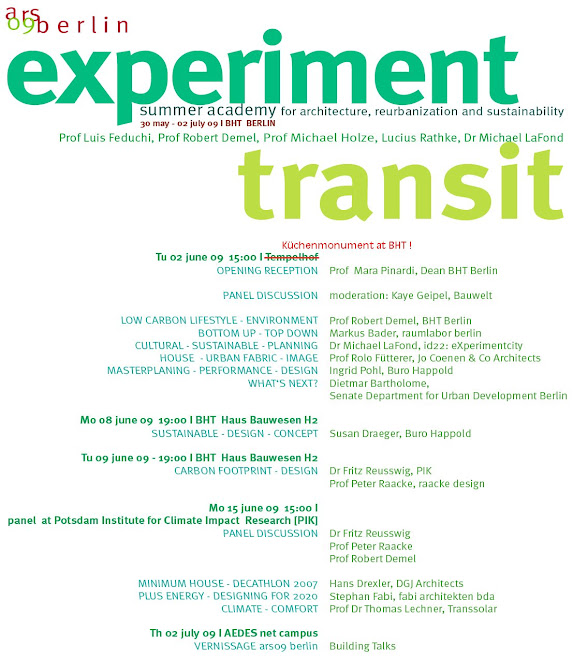
The 4th Edition of the Summer Academy Berlin will be launched in a few days. You are invited to the Opening on 2nd June at 15:00. The event will be held inside the Küchenmonument (Kitchenmonument) designed by Raumlabor and PlastiqueFantastique in front of Haus Bauwesen at Beuth Hochschule der Technik (Luxemburger Str. corner with Tegler Weg).

http://www.kuechenmonument.de/


Once Mara Pinardi opens the international Summer Academy, the following conferences will be held:
L: prof. robert demel/ low carbon lifestyle environment
http://www.summer-academy-berlin.eu
L: markus bader, raumlabor/ bottom up top down
http://www.raumlabor-berlin.de
L: dr. michael lafond, experiment city/ planning participation
http://www.experimentcity.net/

L: prof. rolo fütterer, belval-ouest/ house urban fabric image
http://www.jocoenen.com/fl/e/index_content_small.htm

L: ingrid pohl, masterplaning sustainable/ performance design
http://www.burohappold.com/BH/Home.aspx

L: dietmar bartholome, competition results
http://www.stadtentwicklung.berlin.de/planen/staedtebau-projekte/tempelhof/de/zukunft/index.shtml

Four years ago, as we started with the idea of realising a summer academy concerning sustainable building, it was seen as an innovative proposal. In between, some other relevant Technical Colleges such as the ETH, the University of Wuppertal or Stuttgart have also established summer programs about Energy efficiency.

I am glad that the profile of the Summer Academy of the BHT has been more and more accurate along these four years. It is general knowledge that we are going to build energetic high efficient constructions in the near future, and a mere look into technical press is enough to realize about the importance of the subject in current discourse. The main potential, which is offered here, is whether the strategic environment should only combine nature, construction and technical devices, or whether this new way of building implies a further brand-new aesthetic. The Summer Academy is dealing with such questions this year.

The initial event will go into urban and architectural models regarding the background of the expected climate change. It is predicted that Berlin will have similar conditions in 2050 to current Milan and in 2100 similar to current North Spain or Rome. (Prof. W. Endlicher HU Berlin)

A new Climate IBA (International Building Exhibition) is being discussed for the vacant airport of Tempelhof. Consequently, I consider that would end into the complete construction of the site in 10 or 15 years. By that time, building regulations will be developed so far, that the energetic standards for new constructions might be very near to those of passive houses today, or even more advanced. These standards are based on an avoidance strategy, which also makes sense.

On one hand the question is to which extent it affects the city and its houses. As reference we can find the resulting projects of the Columbia Quartier competition. On the other hand, which influence has climate change to the role of the city? What does a Southern European city look like today? How does public space work? How can climate enrich and condition architecture is another question to which the projects on Columbia Quartier tried to find a response.

I would really appreciate your assistance.
Prof. Robert Demel

building as total system

An innovative concept on the principle of 'saving energy rather than paying to generating it' has resulted in a 'zero-energy building' for Eawag and Empa in Dübendorf: a model of sustainability in action, awarded by the World Sustainable Building Conference. The orientation, massing, envelope, storage mass and solar protection of the office building were optimised so as to avoid the need for a conventional heating system. The building's heating needs are met by using geothermal storage, solar energy and the heat energy produced inside the building by its occupants, computers and lighting.

The rooms are organised into various functional zones, grouped around a five-storey atrium. Cantilevered conference pods, the main staircase and views linking one part with another turn the atrium into a spatial experience. The spaces along the outer walls can be divided flexibly to enable new ways of working and freely networked workplaces. Seminar rooms, a lecture theatre and a staff restaurant broaden the wide variety of rooms provided.

http://www.bgp.ch/English/PR.asp?ID_UT=5&ID=1&FID=1&Offset=2

http://www.sb08.org/
www.forumchriesbach.eawag.ch/dokumente/Eawag_05514.pdf

dancing & kinetic energy

Club Watt features a LED-laden dance floor that is lit up solely by the kinetic energy generated by dancers. The new nightclub will also feature a variety of efficiency standards established by the Sustainable Dance Club group that allow it to save 30% on energy consumption, 50% on water use, cut CO2 emissions by 30%, and reduce waste by 50%.
Home to a thriving young, creative, and diverse population, Rotterdam is the ideal location for Watt. The new club functions as an iconic representation of what the Sustainable Dance Club group is trying to replicate in nightclubs and festivals around the world: an environmentally aware, interactive, sustainable experience.

Watt features a variety of sustainable strategies that include the use of energy-efficient LED lighting instead of powerhungry spotlights, a rainwater catchment’s system that supplies water for its toilets, and waterless urinals which will save an expected 1000 cubic meters of water per year. The club’s LED laden dance floor converts each dancer’s kinetic energy into 20W, allowing it to power itself. These features put the club well on its way to reaching the 50% decrease in CO2 emissions mandated by the Rotterdam Climate Initiative...

http://www.inhabitat.com/2008/10/02/sustainable-dance-club-opens-in-rotterdam/
http://www.sustainabledanceclub.com/index.php?t=txt&tx=3

hypocaust heating

An old farmhouse in the mountains of Switzerland, which for generations had belonged to an alpine farmer's family, had been passed on to their direct descendants. These descendants, now living in the city, approached the Swiss architect Peter Zumthor in 1990 to modernise the house for their holidays, yet "without loosing its magic".

Gugalun means, "looking at the moon". It is a name of a house built by farmers on a northern slope in Grisons canton in Switzerland. Its long life, originated from 1709, has been linked to the serene life of the successive generations. Nowadays, the direct descendants of this family have a very different life characterised by the speed of life imposed by having both their work and their house in the city.

Life in the Swiss canton was characterized by an austerity, which still is present in Gugalun House. The method of construction was typical of Grisons tradition of knitting massive wooden beams. It was heated by a primitive hypocaust, a Roman technique of a central heating system, which relied on a wood fire, and the circulation of warm air that heated the house by means of a big stone stove. All of these qualities of Spartan austerity brought an appreciation for timeless values...

http://storiesofhouses.blogspot.com/2005/09/gugalun-house-by-peter-zumthor.html

MIMOA

vertical farming

By the year 2050, nearly 80% of the earth's population will reside in urban centers. Applying the most conservative estimates to current demographic trends, the human population will increase by about 3 billion people during the interim. An estimated 109 hectares of new land (about 20% more land than is represented by the country of Brazil) will be needed to grow enough food to feed them, if traditional farming practices continue as they are practiced today. At present, throughout the world, over 80% of the land that is suitable for raising crops is in use (sources: FAO and NASA). Historically, some 15% of that has been laid waste by poor management practices. What can be done to avoid this impending disaster?

SOA architects - la tour vivante

Parting between town and countryside, urban and natural spaces, places of consumption, life and production is increasingly problematic for the territory plaParting between town and countryside, urban and natural spaces, places of consumption, life and production is increasingly problematic for the territory planning. The tempting idea of a dense city opposed to a natural landscape comes today with the creation of gigantic places of essential production to the man. These zones outside of the city do not come in any of these categories and give place to increasingly unqualifiable landscapes, destroying the structure of the territory by urban spreading out and polluting the atmosphere by the increasingly important grid systems.

The city, if one can call it so, is spread on the territory with its zones of horizontal production and consumption extracted from the center of the city (trade, factories, storages, greenhouses...), which are heavily consuming space.nning. The tempting idea of a dense city opposed to a natural landscape comes today with the creation of gigantic places of essential production to the man. These zones outside of the city do not come in any of these categories and give place to increasingly unqualifiable landscapes, destroying the structure of the territory by urban spreading out and polluting the atmosphere by the increasingly important grid systems.

http://www.verticalfarm.com/
http://www.eco-tower.fr/

lacaton & vassal _ horticultural social housing

This project for 14 single-family houses is part of an operation for 61 dwellings created by five teams of architects in the extended space of a housing estate in Mulhouse. The aim is to produce quality houses that are, for the same price, considerably larger than the standardized housing usually met with.

To begin with, the creating of a structure and a cheap and effective simple envelope allows to define, on the loft principle, a maximum surface area and volume with contrasting, complementary and surprising spatial qualities. On the ground floor a post/beam structure in concrete supports a platform at a height of 3 m, upon which horticultural greenhouses are fixed. The frame is in galvanized steel, the walls in transparent polycarbonate. Part of the greenhouse is isolated and heated. The other part constitutes a winter gardne, largely ventilated via the roof and facade. A horizontal sunshade unfurls inside the greenhouse.

The greenhouse principle, with its automated climate-control devices, has enabled solutions to the bioclimate to be developped.


http://www.lacatonvassal.com/index.php?idp=19#

sustainable oslo renewal meets herreros arquitectos

The Competition for Oslo Munch Museum was the excuse for the city renewal of its waterfront, creating great potential for recreational and urban redevelopment through a building phenomenon, regarding energy demand and other environmentally important issues.

Won by Herreros Arquitectos, a Spanish office with high experience on recycling waste plants and energetic efficient housing, it is going to introduce a new artifact choosing a posture which shows a double attention towards the fjord and the city. The new building will communicate with the Opera on the same level of importance and opens the new reading of the landscape, introducing a new type of public space and openness in the area...

http://www.herrerosarquitectos.com/HA_ENindProj2_P3-2.html
http://www.haveiendom.no/eng/_hidden/Frontpage/Spanish+and+Norwegian+winners+in+the+Munch%2FSteneresen-+and+Deichman-competitions..9UFRjU1E.ips

can Public-Private Partnerships save detroit?

...Detroit and Indianapolis once had much in common. Thirty years ago, both cities suffered from decreased economic activity, severe unemployment, violence, white flight and racial tensions. But Indianapolis, the nation’s 13th most populous city, has since recovered from those challenges, which were spawned by deindustrialization and suburban job growth.

In 2008, Forbes named Indianapolis as one of its “Ten Best Cities for Jobs,” and CNBC called Indiana the “most improved state for business.” Detroit, by contrast, has continued its decline. It has one of the highest foreclosure rates in the country; swaths of abandoned buildings illustrate the metaphor of a broken city. Although New Orleans and Camden, N.J., bumped Detroit from first place to third in a 2008 list of the most-dangerous cities in America, Detroit is still invoked as a preternatural example of urban blight...


http://americancity.org/daily/entry/1425/

swedish symbiocity

Symbiosis means the integration of two or more organisms in a mutually beneficial union. In Sweden, where for fifty years they have focused on holistic city planning, symbiosis means finding synergies between urban technology systems that save natural resources and cost less.

SymbioCity is the trademark that reflects all knowledge and experience in regard to the Swedish approach to sustainability. Several hundred Swedish consultants, contractors and system suppliers are organised in various networks, dedicated to spreading the vision of sustainable urbanism and making the distance to implementation as short as possible...


www.symbiocity.org